
Castelo de Santa Maria da Feira
Português
Español
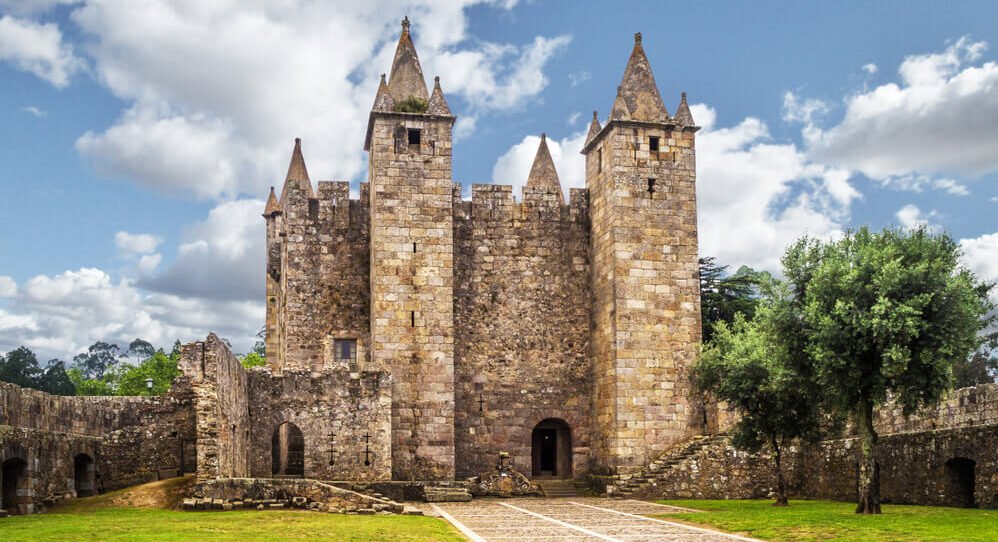
Bienvenido al Castillo de Santa Maria da Feira, uno de los conjuntos patrimoniales más notables de Portugal. Considerado el verdadero ex-libris de esta región, el castillo es una obra destacada de la arquitectura militar portuguesa. Su historia se remonta al siglo décimo y refleja la evolución de los sistemas defensivos a lo largo de toda la época medieval, incluyendo más tarde las innovaciones introducidas por la artillería pirobalística.
El castillo tiene su origen en el período de la Reconquista, anterior a la formación del Reino de Portugal. Durante siglos fue el centro administrativo y militar de una vasta zona conocida como Tierra de Santa María, situada en la margen izquierda del río Duero. En el siglo quince, el Rey Afonso el Quinto transformó este territorio en el Condado de Feira.
Junto a la barbacana se encuentra la capellanía, formada por la casa del capellán y la Capilla de Nuestra Señora de la Encarnación. Esta capilla, de forma hexagonal, fue reconstruida en 1656 por orden de la Condesa Joana Forjaz Pereira, sustituyendo la antigua ermita dedicada a Nuestra Señora del Castillo.
La estructura actual es el resultado de un largo proceso evolutivo marcado por sucesivas transformaciones. Con el tiempo, el castillo se adaptó a distintas funciones: primero como fortificación militar, después como residencia señorial de los Condes de Feira y, finalmente, como Monumento Nacional, un estatus que mantiene desde 1910.
English
Welcome to the Castle of Santa Maria da Feira, one of the most remarkable heritage landmarks in Portugal. Considered the true ex-libris of this region, the castle is a striking example of Portuguese military architecture. Its history goes back to the 10th century and reflects the evolution of defensive systems throughout the medieval period, including later innovations introduced by pyrotechnic weaponry.
The origin of the castle is linked to the period of the Reconquest, before the formation of Portugal as a nation. For centuries, it served as the administrative and military centre of a vast area known as Terra de Santa Maria, located on the left bank of the Douro River. In the 15th century, King Afonso the Fifth transformed this territory into the County of Feira.
Next to the barbican lies the chaplaincy, consisting of the chaplain’s house and the Chapel of Our Lady of the Incarnation. This hexagonal chapel was rebuilt in 1656 on the orders of Countess Joana Forjaz Pereira, replacing the old hermitage dedicated to Our Lady of the Castle.
The structure you see today is the result of a long evolutionary process marked by successive transformations. Over time, the castle adapted to different roles: first as a military fortification, then as the noble residence of the Counts of Feira, and finally as a National Monument, a status it has held since 1910.
Français
Bienvenue au Château de Santa Maria da Feira, l’un des ensembles patrimoniaux les plus remarquables du Portugal. Considéré comme le véritable ex-libris de la région, le château est un exemple emblématique de l’architecture militaire portugaise. Son histoire remonte au dixième siècle et reflète l’évolution des systèmes de défense tout au long du Moyen Âge, ainsi que les innovations ultérieures liées aux armes pyrotechniques.
L’origine du château est liée à la période de la Reconquête, antérieure à la formation du Royaume du Portugal. Pendant des siècles, il fut le centre administratif et militaire d’un vaste territoire appelé Terre de Santa Maria, situé sur la rive gauche du fleuve Douro. Au quinzième siècle, le Roi Afonso le Cinquième transforma cette région en Comté de Feira.
À côté de la barbacane se trouve la chapellenie, composée de la maison du chapelain et de la Chapelle de Notre-Dame de l’Incarnation. Cette chapelle hexagonale fut reconstruite en 1656 sur ordre de la Comtesse Joana Forjaz Pereira, remplaçant l’ancienne ermite dédiée à Notre-Dame du Château.
La structure actuelle est le résultat d’un long processus évolutif marqué par de nombreuses transformations. Au fil du temps, le château s’est adapté à différentes fonctions : d’abord fortification militaire, puis résidence seigneuriale des Comtes de Feira, et enfin Monument National, titre qu’il détient depuis 1910.